
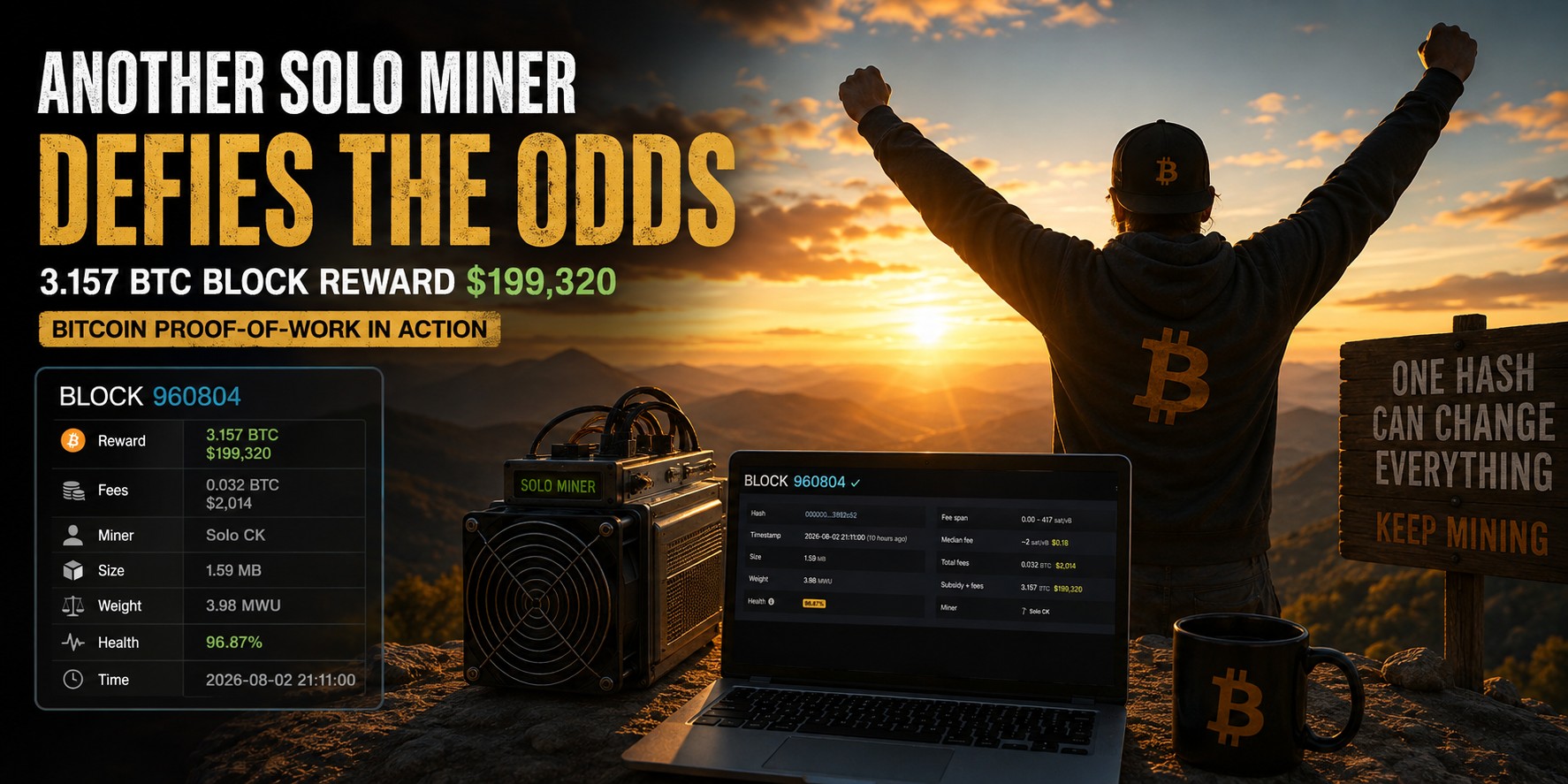
A solo Bitcoin miner has once again beaten astronomical odds, successfully mining Bitcoin block #960804 and earning a reward of 3.157 BTC, worth approximately $199,320 at the time of discovery.
According to blockchain data, the block was mined via Solo CK, one of the best-known services that allows miners to participate in Bitcoin mining individually while using shared infrastructure. The miner collected the entire block reward—including transaction fees—instead of sharing it with thousands of participants in a traditional mining pool.
The achievement quickly spread across social media after Bitcoin Magazine highlighted the event, calling the miner a “legend.”
The block contained nearly 4 MB of transaction weight, generated approximately 0.032 BTC in fees, and was mined with a reported network health of 96.87%.
Is This Becoming More Common?
Although many headlines describe these victories as once-in-a-lifetime events, solo block discoveries have become noticeably more frequent over the last two years.
Several factors explain why:
- More hobbyists are experimenting with home mining.
- Open-source ASIC miners such as Bitaxe and NerdQaxe have become popular.
- Services like Solo CKPool and Public Pool have made solo mining much easier.
- Some miners temporarily rent large amounts of hashpower in an attempt to win a block.
Rather than running an industrial mining farm, many modern “solo miners” are simply individuals choosing not to split rewards with others.
Several Solo Wins in Recent Months
This latest success is far from an isolated event.
Recent examples include:
- A solo miner earning approximately $222,000 after mining block 944,306 in April 2026.
- A tiny 1 TH/s Bitaxe miner astonishing the Bitcoin community by solving a block worth roughly $200,000, despite odds measured in thousands of years of expected mining time.
- Multiple additional Solo CK and Public Pool winners recorded throughout 2026, averaging roughly one successful solo block every couple of weeks.
This demonstrates that while each individual miner still faces extremely small odds, the growing number of solo participants naturally leads to more success stories.
Lottery Ticket or Investment?
For most miners, solo mining remains closer to buying a lottery ticket than operating a profitable business.
Mining pools were created because Bitcoin rewards are highly unpredictable. By combining computing power, participants receive smaller but regular payouts instead of waiting months—or centuries—for a single jackpot.
Solo mining completely reverses that model:
- Find a block → keep the entire reward.
- Never find a block → earn nothing.
Mathematically, the expected return remains similar over very long periods, but the variance is dramatically higher.
Why These Stories Matter
These stories capture the imagination because they reinforce one of Bitcoin’s founding principles: anyone can participate.
Unlike many industries where only large corporations can compete, Bitcoin’s protocol does not distinguish between multinational mining companies and someone running a miner from a garage. Every valid hash has exactly the same chance of solving the next block.
In practice, industrial miners dominate because of their enormous computing power, but occasional solo victories remind the community that Bitcoin remains an open, permissionless network.
Final Thoughts
No one should interpret these stories as evidence that buying a small miner is a reliable way to make money. The economics still overwhelmingly favor large-scale mining operations with access to inexpensive electricity and modern ASIC hardware.
However, every successful solo block serves as a reminder that Bitcoin is built on probability rather than privilege.
Sometimes, the smallest participant really does win.