
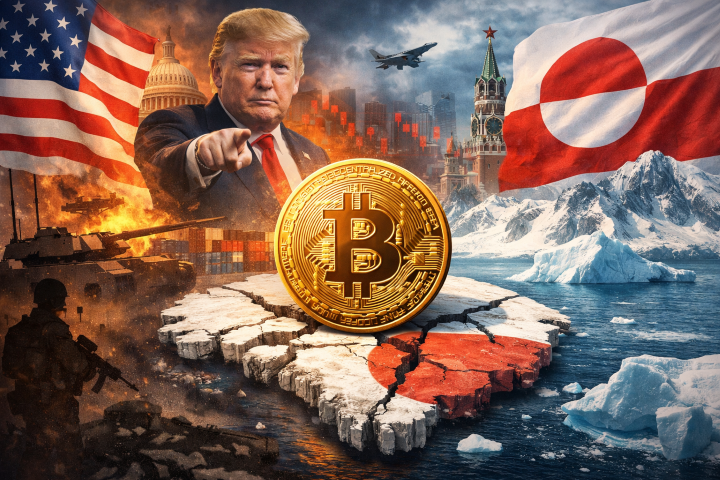
For years, Bitcoin advocates have argued that the cryptocurrency functions as a hedge against political instability—a borderless, neutral asset immune to the decisions of governments and global power blocs. Recent developments surrounding Greenland, however, challenge that narrative.
When speculation intensified over whether the United States might escalate its rhetoric—and potentially its actions—regarding Greenland, Bitcoin did not behave like a safe haven. Instead, it traded as a classic risk-on asset, sensitive to geopolitical uncertainty, trade policy, and broader macro sentiment.
Greenland, Trump, and Market Anxiety
Concerns peaked after statements from Donald Trump suggested the United States had a strategic interest in Greenland, an autonomous territory within the Kingdom of Denmark. While outright military action was ultimately ruled out, the possibility of tariffs, trade retaliation, or diplomatic escalation weighed heavily on global markets.
This mattered because Greenland is not just a symbolic territory—it sits at the crossroads of Arctic security, rare earth resources, and NATO geopolitics. Any serious conflict involving Denmark, a NATO member, would represent a structural shock to global stability.
Bitcoin reflected this anxiety. As rhetoric hardened, BTC drifted lower, failing repeatedly to reclaim key psychological levels. When Trump later softened his tone and stepped back from tariffs and military threats, markets—including Bitcoin—reacted with relief.
The takeaway was clear: Bitcoin responded not as a geopolitical hedge, but as a high-beta asset aligned with broader risk sentiment.
Bitcoin Is Still a Risk Asset
This episode reinforces a pattern that has become increasingly visible over the last two years. As Bitcoin integrates more deeply into institutional portfolios, it behaves less like digital gold and more like a macro-sensitive financial instrument.
Trade wars, tariffs, and diplomatic standoffs affect liquidity, investor confidence, and capital allocation. Bitcoin is no longer insulated from these forces. Instead, it reacts alongside equities, growth assets, and other speculative instruments.
Market analysts have repeatedly noted that uncertainty—especially around trade policy—has been one of the largest drags on Bitcoin’s performance. Even strongly pro-crypto political messaging has proven insufficient to offset the negative impact of tariffs, tightening liquidity, and geopolitical brinkmanship.
Greenland as a Macro Signal, Not a Crypto Story
Importantly, Greenland itself is not a “Bitcoin issue.” It is a macro issue. But Bitcoin now lives inside the macro world.
As adoption grows and Bitcoin becomes embedded in pension funds, ETFs, and corporate balance sheets, it becomes more exposed to the same forces that move traditional markets:
-
Trade relations
-
Military alliances
-
Tariff regimes
-
Diplomatic credibility
In this environment, Bitcoin’s price action reflects global confidence—or the lack of it.
No Haven, Just Exposure
The Greenland episode highlights a sobering reality for investors. Bitcoin may still offer long-term structural appeal, scarcity, and censorship resistance—but in the short to medium term, it is not immune to geopolitical risk.
On the contrary, it is increasingly exposed to it.
For investors, this does not invalidate Bitcoin as an asset. But it does demand a more realistic framework: Bitcoin is not a geopolitical escape hatch. It is a participant in the global financial system, subject to its shocks, pauses, and recalibrations.
As long as trade wars, security alliances, and political leverage shape global liquidity, Bitcoin will move with them—not against them.